Missouri is the first state in the nation to comprehensively integrate the common processes involved in the medical treatment of time-critical conditions. Legislated by Missouri House Bill 1790, the state’s Time Critical Diagnosis (TCD) statute is designed to ensure the timely and appropriate emergency medical treatment for people who suffer trauma, stroke and the potentially fatal form of heart attack known as STEMI (ST-segment elevation myocardial infarction).
In Missouri, the idea behind TCD was initially proposed by John William Jermyn III, DO, a Barnes-Jewish Hospital emergency physician, the first emergency medical services (EMS) director for the state of Missouri and an EMS advocate.
“It is widely known in Missouri that Dr. Jermyn was the champion for the TCD system,” says David Tan, MD, medical director of Washington University EMS. “Unfortunately, the legislation passed one day after Bill died, but without his work and passion for improving emergency medicine, this would not have come about.”
The TCD statute passed in July 2008, but regulations that will mandate how TCD is implemented are still being considered. “The plan and the hope is that they will be passed in 2013,” says Brian Froelke, MD, Washington University emergency medicine physician at Barnes-Jewish Hospital. “A huge benefit of the bill is that it’s a living document, allowing the regulations to be updated as the practice of medicine changes.”
The Missouri Department of Health and Senior Services has issued the following statement about TCD and its impact: “The TCD system represents the continuum of services, beginning with public education about prevention, recognition of signs and symptoms, and the importance of immediately seeking care. It then circles through the series of system components to emphasize evidencebased and best practices for incident recognition, first aid, 911 access, response coordination, prehospital response, transport, emergency department care, acute medical care and rehabilitation. Finally, it incorporates quality-improvement processes through the system.”
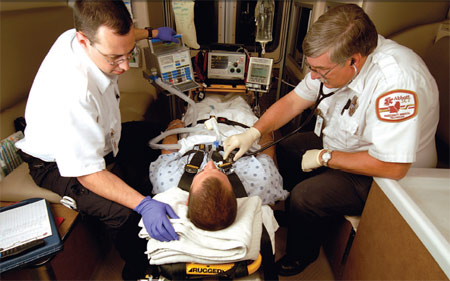
TCD’s goal is to ensure patients are transported to a hospital that has the equipment and infrastructure to offer the best outcome. “It makes sense to transport patients with emergent conditions another four minutes so they will have access to the specialized care they need,” says Bill Warsing, CCEMTP, PNCCT, lead paramedic, specialty care transport, with Abbott EMS/AMR. He is dual-licensed in Missouri and Illinois and has been a paramedic for 15 years.
Warsing explains that before TCD, the law simply required that a patient be taken to the closest hospital. “Many patients thought that a hospital was a hospital; that you would get the same care no matter where you went.”
But as health care has become increasingly advanced and procedures more complex, a one-size-fits-all attitude can be costly to the patient. Once the new TCD system is enacted, hospitals will be designated as trauma, stroke and STEMI centers by the state of Missouri and, by law, patients with these conditions may be taken to these recognized centers.
In fact, some area hospitals already have been designated as trauma, stroke and STEMI centers. Barnes-Jewish Hospital was first nationally recognized as a Level I trauma center by the American College of Surgeons in 1996 and has maintained that verification ever since.
According to Froelke, TCD also provides a framework for transfers so that stroke and STEMI patients don’t have to wait the usual two-and-a-half hours for a transfer from a hospital that is not equipped to expedite their care.
“Having lost my father to a stroke, I regard TCD in a very personal way,” says Tan. “The crucial link to survival is prehospital care–knowing the signs for these conditions, knowing what to do and where to take the patient. There is a reason that the state’s slogan for TCD is ‘Right care. Right place. Right time.’”